



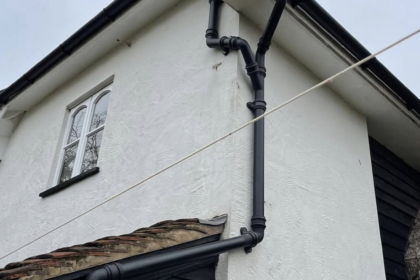
 How to Prevent Downpipe Failures
Why Your Gutter Downpipes Matter as Much as Your Roof — and How to Avoid Common Failures
When you think about protecting your home from the elements, your first thought is no doubt the roof. That’s fair enough, since without the roof working efficiently, you’d be at the mercy of the weather.
You might also think about the gutters along the edge of the roof — but how many people would focus on the downpipes? Yet they have just as vital a function as anything in preventing your home from flooding, suffering from damp or even from subsidence.
What Do the Downpipes Do?
After heavy rain, the water can pool on the roof, and the weight can put extra pressure on the roofing materials. This may create cracks or tiny gaps, allowing damp to get into the roofspace and further down, creating mould and rot.
Alternatively, if the water is simply allowed to spill over the edge of the roof, it has the potential to damage the masonry as it flows down the walls. It will also pool on the ground below, and from there it can get into the foundations, eventually causing subsidence.
This is avoided by the water being caught in the gutters. Crucially, these channel it into the downpipes, which take it straight down into the drains, allowing it to flow safely away from your home without doing damage.
What Can Go Wrong With Downpipes?
There are four common faults that can result in downpipes failing to do their job properly:
- Getting clogged with leaves, moss or twigs. This is a particular problem if there are trees overhanging the roof, but old roofs can also cause this issue. If the downpipes are blocked, the water will remain in the gutters and spill over.
- Inadequate fixing or alignment. This can be caused either by poor workmanship initially or else by wind or temperature fluctuations pulling the pipes away from the wall, which can result in leaks.
- Damage to the materials. This is a particular problem with older, iron pipes, which tend to corrode and cause leaks.
- Bad alignment at ground level. If the pipes don’t discharge directly into a drain or a gully, the water can saturate the masonry and foundations, leading to a freeze-thaw cycle causing cracks.
The key to preventing failures in your downpipes, and therefore serious damage to your home, is regular inspection and maintenance. Your downpipes, along with the gutters, should be examined at least twice a year, and additionally after a storm, a freezing spell or a heatwave.
Things to check are whether the pipes are blocked and whether they’ve become damaged or misaligned. The pipes can be rodded to clear them, and any repairs needed should be done straight away. Even if there’s no actual damage, you might want to consider replacing old pipes with modern materials, such as uPVC.
While some of this can be done by experienced DIYers, it’s always best to call in an expert roofer, who can spot issues you might miss and make professional, guaranteed repairs to your roof, gutters and downpipes.
Give Empire a call to find out more about how we can make sure your downpipes continue to do their job of protecting your home.